Mostly, it gets difficult to remember which conventions to use where, especially when writing for a British audience, as I am when I work over here. When I bring some of these conventions and colloquialisms back to the US, people think I'm being smarmy or hoity-toity, which is usually not the case at all. Saying 'cheers' becomes second-nature here, as does asking where the 'loo' or 'toilet' is. If you're looking for zucchini, you'd better look for a corgette instead, or you probably will go home empty-handed. And if you want something 'to go,' you'd better ask for 'take away.' I could go on and on about the subtle changes between American and British English. It takes a me a few weeks to acclimate myself once I'm over here.
Showing posts with label language. Show all posts
Showing posts with label language. Show all posts
Sunday, 31 May 2009
Acclimation...
This is a fascinating wikipedia entry on the differences between British and American English. It's strange, I read so many British books as a kid, that I use some British grammatical rules without realizing it. Sadly, I think spell-checking programs are solidifying the differences between British and American spelling, especially when doubling consonants in front of a suffix with a vowel. For example, I still write travelling, but most spellchecking programs tell me that traveling is the correct spelling, which looks totally wrong to me. (Wikipedia also has an interesting article on the different spelling conventions of the two countries.)


Saturday, 1 September 2007
Realization of the Day:
A haircut can change one's outlook entirely!
It can! I promise! I found out that the salon a block away from my dorm is an Aveda salon and so I went in today to see if they had an appointment open. Since I have such short hair, if I don't get a trim every couple of months I start to look really grungy, and not in that good, early 90s way (was that ever good?). I was heading down the path to mullet-ville and in a reasonably homesick mood, so I decided to throw caution to the wind and try the random salon!
The thing with short hair is, one small misstep and one can look very much like a guy. Let's face it, I'm not exactly the most feminine woman in the world; I like being androgynous (I think it adds to my quirky charm, don't you?) so I like having shorter hair, but there's always a risk that someone is going to give me a really bad cut.
Not today! The woman who cut my hair was tremendous. She ever-so-carefully cut each section, sometimes stopping to cut a single stray hair. The result? A wonderful pixie cut with short 'fringe' (or bangs in the U.S., as I soon realized). I am a very happy camper, feeling much lighter, and ready to take on the world again! Grrr!
It can! I promise! I found out that the salon a block away from my dorm is an Aveda salon and so I went in today to see if they had an appointment open. Since I have such short hair, if I don't get a trim every couple of months I start to look really grungy, and not in that good, early 90s way (was that ever good?). I was heading down the path to mullet-ville and in a reasonably homesick mood, so I decided to throw caution to the wind and try the random salon!
The thing with short hair is, one small misstep and one can look very much like a guy. Let's face it, I'm not exactly the most feminine woman in the world; I like being androgynous (I think it adds to my quirky charm, don't you?) so I like having shorter hair, but there's always a risk that someone is going to give me a really bad cut.
Not today! The woman who cut my hair was tremendous. She ever-so-carefully cut each section, sometimes stopping to cut a single stray hair. The result? A wonderful pixie cut with short 'fringe' (or bangs in the U.S., as I soon realized). I am a very happy camper, feeling much lighter, and ready to take on the world again! Grrr!
Thursday, 23 August 2007
Realization of the Day:
What?
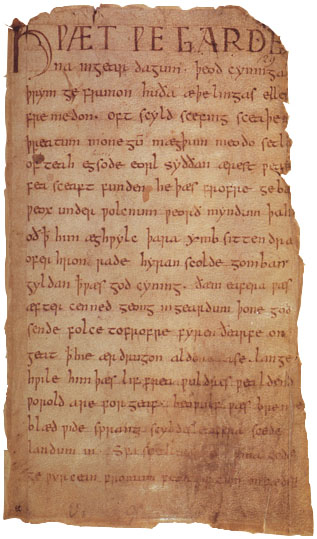
That's the Beowulf Codex, well the first page from the poem Beowulf, anyway. It's been through a lot in the 1,100 years since it's been made. In 1731, it barely made it out of the Cottonian Fire, as its scorched edges attest. Even in the 15th century, people couldn't read the first lines of Beowulf, not without a lot of trouble anyway. In the 18th century, people like Cotton were just getting interested in the 'ancient' English language. The half-scorched manuscript is the only copy of this poem that survives. It's terrifying (at least for me) to think of a life without this story. If you want to hear the first few lines recited, click on this link.

Hwæt We Gardena
What We of the Spear-Danes
in gear dagum þeod cyninga
in old days of the people-kings
þrym ge frunon hu ða æþlingas ellen
power heard how the Aethlings brave deeds
fremedon.
did.
There are 4 letters in that little bit that we don't use today. That's why the word 'hwaet' looks like 'hpaet'. Those letters are holdovers from the runes that the Germanic languages used before the Romans came around. The smaller text is a literal translation, and does little to capture the poetry and alliteration that come with such a wonderful opening stanza. Here's a translation that's only a little better:
Lo, praise of the prowess of people-kings
of spear-armed Danes, in days long sped,
we have heard, and what honor the athelings won!
Anyway, this is just to say that I got to look through this manuscript today, if only for a little while. It's one of the most important pieces of literature from the Anglo-Saxon period (pre 1066 A.D.) that survives. As a person who studies manuscripts, this is like winning the Superbowl and taking the fabled trip to Disneyland afterwards. Not only did I get to see it, I got to talk about it with the scholar and curator who were examining the manuscript. I think I can go to bed with a smile on my face tonight.
That's the Beowulf Codex, well the first page from the poem Beowulf, anyway. It's been through a lot in the 1,100 years since it's been made. In 1731, it barely made it out of the Cottonian Fire, as its scorched edges attest. Even in the 15th century, people couldn't read the first lines of Beowulf, not without a lot of trouble anyway. In the 18th century, people like Cotton were just getting interested in the 'ancient' English language. The half-scorched manuscript is the only copy of this poem that survives. It's terrifying (at least for me) to think of a life without this story. If you want to hear the first few lines recited, click on this link.

Hwæt We Gardena
What We of the Spear-Danes
in gear dagum þeod cyninga
in old days of the people-kings
þrym ge frunon hu ða æþlingas ellen
power heard how the Aethlings brave deeds
fremedon.
did.
There are 4 letters in that little bit that we don't use today. That's why the word 'hwaet' looks like 'hpaet'. Those letters are holdovers from the runes that the Germanic languages used before the Romans came around. The smaller text is a literal translation, and does little to capture the poetry and alliteration that come with such a wonderful opening stanza. Here's a translation that's only a little better:
Lo, praise of the prowess of people-kings
of spear-armed Danes, in days long sped,
we have heard, and what honor the athelings won!
Anyway, this is just to say that I got to look through this manuscript today, if only for a little while. It's one of the most important pieces of literature from the Anglo-Saxon period (pre 1066 A.D.) that survives. As a person who studies manuscripts, this is like winning the Superbowl and taking the fabled trip to Disneyland afterwards. Not only did I get to see it, I got to talk about it with the scholar and curator who were examining the manuscript. I think I can go to bed with a smile on my face tonight.
Tuesday, 31 July 2007
Realization of the Day:
It sucks to be sick in a foreign country without minions.
Okay, not minions, but someone to go get ginger ale and advil. I woke up last night with a really awful sore throat and a fever, complete with aches and pains. Me thinks I have the flu. So what do I do? I call Kevin and my dad and mom so I can whine about my sorry state. I haven't cried about missing anyone since I got here, but last night, as I hoped I wouldn't have to bust out my health insurance cards at foreign urgent care centers, I was sniffling a lot.
I know it's 'just England' and I don't have to mime my maladies to a doctor that doesn't speak my language, but it takes a good fifteen minutes of staring at a map to figure out how to get to a bookstore that's down the street, so finding some kind of doctor wasn't high on my list of things I wanted to do whilst I was here. (Oh, and just as an example of how things are different here: yeast infections. (close your eyes, boys.) If you go to a pharmacist and tell him/her that you have a yeast infection, they will think you have an STD. One must say they need medication for...wait for it... thrush instead. What did a hapless bird do to these people?)
I'm very glad that I decided to buy a can of rice pudding, since it was the perfect thing for my throat along with some tasty ginger beer. (See, I just use being sick as a way to try new foods!) So I've slept all day; hopefully I'll make it to work tomorrow since my boss comes back from her 2-week holiday and I want to make sure that I'm there when she gets in.
Okay, not minions, but someone to go get ginger ale and advil. I woke up last night with a really awful sore throat and a fever, complete with aches and pains. Me thinks I have the flu. So what do I do? I call Kevin and my dad and mom so I can whine about my sorry state. I haven't cried about missing anyone since I got here, but last night, as I hoped I wouldn't have to bust out my health insurance cards at foreign urgent care centers, I was sniffling a lot.
I know it's 'just England' and I don't have to mime my maladies to a doctor that doesn't speak my language, but it takes a good fifteen minutes of staring at a map to figure out how to get to a bookstore that's down the street, so finding some kind of doctor wasn't high on my list of things I wanted to do whilst I was here. (Oh, and just as an example of how things are different here: yeast infections. (close your eyes, boys.) If you go to
I'm very glad that I decided to buy a can of rice pudding, since it was the perfect thing for my throat along with some tasty ginger beer. (See, I just use being sick as a way to try new foods!) So I've slept all day; hopefully I'll make it to work tomorrow since my boss comes back from her 2-week holiday and I want to make sure that I'm there when she gets in.
Saturday, 28 July 2007
Realization of the Day:
I finally understand this whole "Cheers!" thing.
I've made it a personal goal to get people to smile here. My colleagues at WBL tell me that people only say hello to each other in the country. Perhaps that's why I really like the friendliness of the little villages in the UK. People here make fun of the super nice American wait staff at restaurants, something that I usually don't enjoy if I'm served by a complete tool, but when a person smiles a little, it brightens my day. When I walk down the road to work people walk very fast, look straight ahead with a stony face, and even when they almost run into someone they don't say a word. Granted I'm walking right by King's Cross a lot, one of the biggest tube/train stops in London, but still.
There's nothing better to a person abroad than a local giving that person a smile. I've had the most luck with the Waitrose checkout people. I think they probably get tired of the usual grim Londoner not even looking them in the eye. The wait staff in the British Library canteen just think I'm completely hapless, so they take pity on me and smile when they see me.
Today I experimented a little. Instead of saying "have a nice day," my usual mantra after purchasing something, I tried the much more colloquial, "cheers!" I almost fell over when the man at the video store smiled and said it as well. Now I'm trying to define this pesky word. It's not "thanks," because I hear people saying "thanks! cheers!" It's an innocuous phrase that many a pretentious American appends to the end of his/her email to sound...I don't know...smarmy? When I see cheers in that context, it almost always makes me think mean thoughts. But here, it's a powerful little word. It's a combination of 'have a nice day, thanks for your help' and a general acknowledgment that someone did something for you.
In the right context, (i.e. whilst I'm here) this is a powerful little word that I plan to use more often!
I've made it a personal goal to get people to smile here. My colleagues at WBL tell me that people only say hello to each other in the country. Perhaps that's why I really like the friendliness of the little villages in the UK. People here make fun of the super nice American wait staff at restaurants, something that I usually don't enjoy if I'm served by a complete tool, but when a person smiles a little, it brightens my day. When I walk down the road to work people walk very fast, look straight ahead with a stony face, and even when they almost run into someone they don't say a word. Granted I'm walking right by King's Cross a lot, one of the biggest tube/train stops in London, but still.
There's nothing better to a person abroad than a local giving that person a smile. I've had the most luck with the Waitrose checkout people. I think they probably get tired of the usual grim Londoner not even looking them in the eye. The wait staff in the British Library canteen just think I'm completely hapless, so they take pity on me and smile when they see me.
Today I experimented a little. Instead of saying "have a nice day," my usual mantra after purchasing something, I tried the much more colloquial, "cheers!" I almost fell over when the man at the video store smiled and said it as well. Now I'm trying to define this pesky word. It's not "thanks," because I hear people saying "thanks! cheers!" It's an innocuous phrase that many a pretentious American appends to the end of his/her email to sound...I don't know...smarmy? When I see cheers in that context, it almost always makes me think mean thoughts. But here, it's a powerful little word. It's a combination of 'have a nice day, thanks for your help' and a general acknowledgment that someone did something for you.
In the right context, (i.e. whilst I'm here) this is a powerful little word that I plan to use more often!
Monday, 9 July 2007
Realization of the Day (A Two-Parter):
I've come to rely on my cellphone far too much.
I don't have a cellphone whilst I'm here. I decided that since I really don't know anyone here who isn't easily accessible by email that it was pretty much worthless to spend $60 on something I didn't need. Besides, I have a phone in my dorm-hovel that has voice-mail and an automated wakeup call.
I also forgot my watch, which has proven to be more problematic. I've started to use my cellphone as my watch, as I think most people have, so since I've gotten here I've had no idea what time it was unless I was near my laptop or my work computer.
I broke down yesterday and bought a watch on amazon.co.uk. It's one of the cheapest ones I found that still looked half-way decent and something that I'd choose to wear on a regular basis.
American English and British English are funny.
(Watch my brilliant segue into my next topic!) Amazon just emailed me telling me: "Your Amazon.co.uk order has dispatched." Dispatched? I usually only use the verb in its past perfect tense, and then usually in the sense that a person was dispatched, not an object.
Another grammatic oddity I've noticed came from the ATM machine that Dr. Virago and I were using. While we waited for our respective money the machine said: "Please wait while we deal with your request." In American English, 'dealing with' something definitely has pejorative connotations.
It's definitely hard to get my meaning across here. It's not that the words that the Brits use aren't in my lexicon, it's just that they're not the first words I would choose in most cases. I'm getting more fluent in British English, but it's definitely taking some getting used to!
I don't have a cellphone whilst I'm here. I decided that since I really don't know anyone here who isn't easily accessible by email that it was pretty much worthless to spend $60 on something I didn't need. Besides, I have a phone in my dorm-hovel that has voice-mail and an automated wakeup call.
I also forgot my watch, which has proven to be more problematic. I've started to use my cellphone as my watch, as I think most people have, so since I've gotten here I've had no idea what time it was unless I was near my laptop or my work computer.
I broke down yesterday and bought a watch on amazon.co.uk. It's one of the cheapest ones I found that still looked half-way decent and something that I'd choose to wear on a regular basis.

American English and British English are funny.
(Watch my brilliant segue into my next topic!) Amazon just emailed me telling me: "Your Amazon.co.uk order has dispatched." Dispatched? I usually only use the verb in its past perfect tense, and then usually in the sense that a person was dispatched, not an object.
Another grammatic oddity I've noticed came from the ATM machine that Dr. Virago and I were using. While we waited for our respective money the machine said: "Please wait while we deal with your request." In American English, 'dealing with' something definitely has pejorative connotations.
It's definitely hard to get my meaning across here. It's not that the words that the Brits use aren't in my lexicon, it's just that they're not the first words I would choose in most cases. I'm getting more fluent in British English, but it's definitely taking some getting used to!
Subscribe to:
Posts (Atom)